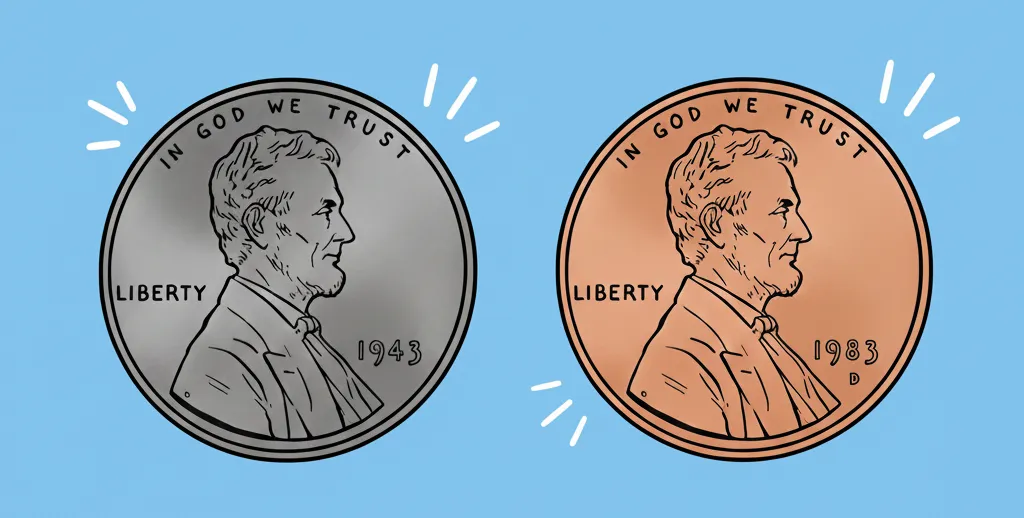
1991 quarter errors attract strong attention online. But, frankly speaking, all that glitters is not gold. Most of them are ordinary circulation damage.
Real mint errors do exist, but they are specific and identifiable. The main challenge is separating factory mistakes from post-mint abuse.
Below, we would like to find out what truly exists, what carries value, and what does not.
The 1991 Washington Quarter: Basic Overview
Before discussing errors, it helps to understand the standard coin:
Specifications
Parameter | Specification |
Year | 1991 |
Series | Washington Quarter |
Composition | Copper core with nickel-clad outer layers |
Weight | 5.67 grams |
Diameter | 24.3 mm |
Edge | Reeded |
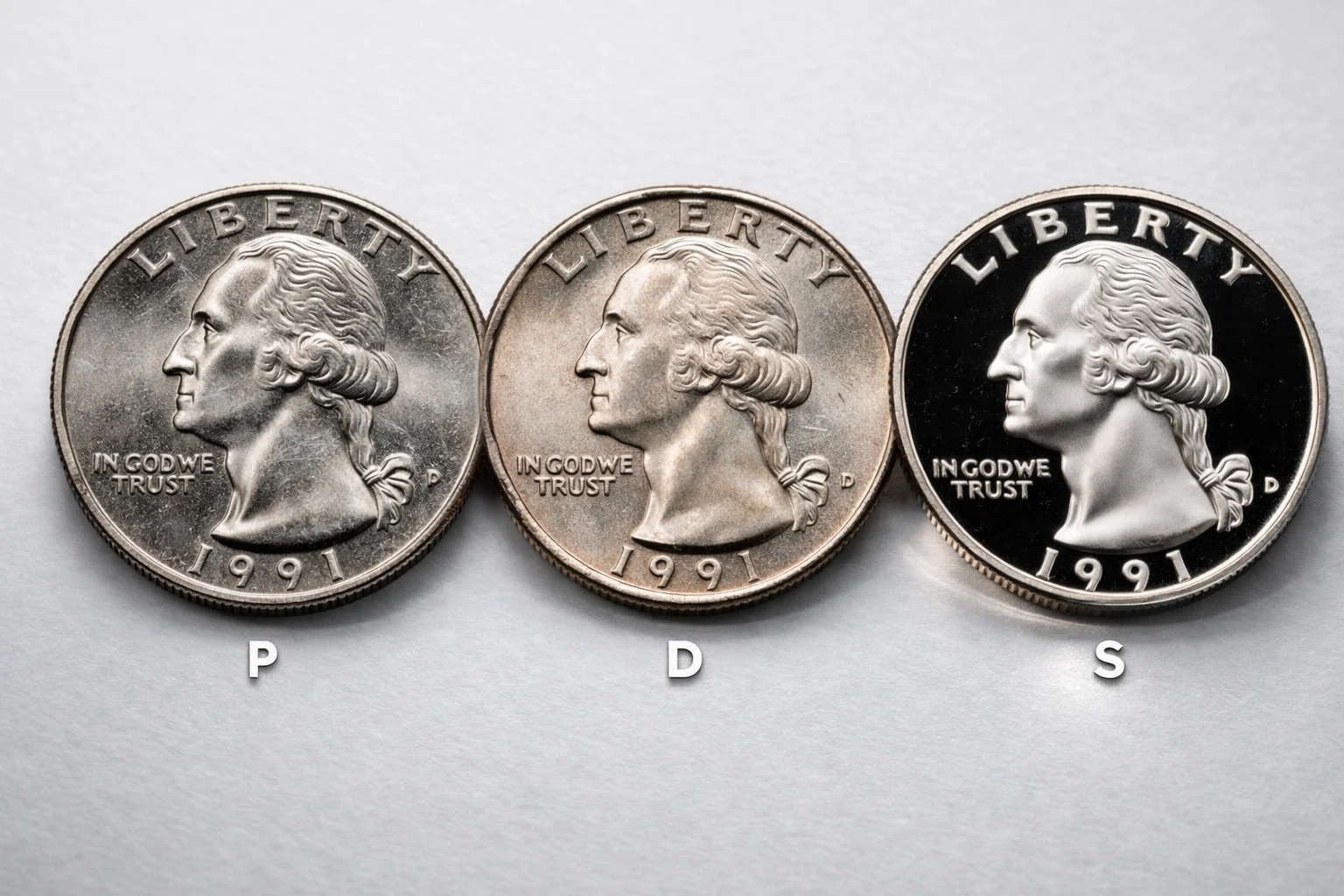
Mint Marks | P, D (circulation) / S (proof) |
Designer | John Flanagan |
In 1991, circulation strikes were produced at the Philadelphia and Denver mints. San Francisco struck proof quarters only.
All three versions share the same clad composition. The difference lies in strike type. Proof coins feature polished dies and mirrored fields, while circulation coins were struck for everyday use.
Surface behavior also differs. Circulation pieces show contact marks quickly. Proof coins reveal hairlines and haze more easily because of their mirror finish.
Mintage and Market Reality
Circulation strikes:
1991-P: ~570,000,000
1991-D: ~630,000,000
Proof issue:
1991-S Proof: ~3,000,000
Philadelphia and Denver coins are common in all circulated grades. Most trade at face value.
The 1991-S proof is also widely available in PR65–PR68. Premiums increase only at PR69 and especially PR70 Deep Cameo levels.
A certified 1991-D in MS67 has reached roughly $1,950 at auction due to condition rarity. That result reflects preservation, not mintage.
For quick confirmation of mint mark, strike type, and technical details before evaluating potential anomalies, Coin ID Scanner can help verify specifications using its large coin database and built-in assistant.
Real 1991 Quarter Errors
Only a handful of error categories are relevant for this year. Each must show clear mint-origin characteristics.
Black Beauty (Annealing Error)
This is one of the most talked-about 1991 quarter errors.
A “Black Beauty” occurs when the planchet is improperly annealed during production. The metal is overheated or inconsistently treated. The result is a very dark, almost black appearance.
Main points:
Color is uniform, not patchy.
Surfaces remain uncirculated in texture.
The tone is metallic, not dirty.
Environmental damage can also darken coins. The difference lies in texture. Corrosion creates roughness and pitting. A true annealing error keeps sharp detail and intact surfaces.
Certified examples bring solid premiums. Dramatic pieces can reach hundreds of dollars depending on eye appeal and condition.
Doubled Die Obverse and Reverse (DDO / DDR)
True doubled dies are collectible. Mechanical doubling is not.
On confirmed 1991 pieces, doubling has been reported on:
LIBERTY
The date
Eagle’s beak
Wing feathers
A true double die shows separation. Letters appear thickened with clear secondary outlines. The doubling is part of the design.
Machine doubling looks flat. It creates a shelf-like shift. There is no rounded separation.
Magnification is required. Many coins labeled as DDO are simply strike deterioration or machine movement.
Certified examples of real doubled dies carry strong collector interest. Minor machine doubling has little to no premium.
Clipped Planchet
A clipped planchet occurs before striking. During the punching of blank discs from a metal strip, a misalignment leaves a crescent-shaped missing section.
Characteristics of a genuine clip:
A smooth, curved cut.
Disturbed rim at the clip area.
Blakesley effect — weakness directly opposite the clip.
Damage from pliers or impact leaves jagged edges. It often shows bending or distortion. A real clip maintains uniform metal flow.
Depending on size, clipped planchets can sell from $50 to over $200. Larger clips with visible date command higher prices.
Die Cracks and Cuds
Die cracks are common in high-production years.
Die Crack
A raised line on the coin surface is caused by a cracked die. It is thin and follows stress lines.
Cud
A larger break along the rim. It appears as a raised metal blob where part of the die has broken away.
The 1991 quarter sometimes shows cracks near Washington’s eye or across the reverse.
Small cracks carry modest value. Larger rim cuds are more desirable. Dramatic cuds can reach into the hundreds depending on size and location.
The key feature: raised metal. If the line is incuse or cut into the coin, it is damaged.
Struck Through Grease
Excess grease can fill recessed areas of the die. When struck, parts of the design appear weak or missing.
Examples include:
Faded letters
Weak numbers in the date
Partial disappearance of design elements
Struck-through grease errors are common. Most are minor. Dramatic examples with clear missing details can carry small premiums.
Grease errors differ from wear. Wear removes detail through friction. Grease errors show smooth but incomplete strikes.
What Is Not a Mint Error
Many supposed errors are simply damage.
Environmental Damage
Soil exposure, moisture, and chemicals corrode clad layers. The result is discoloration and pitting. This is not collectible.
Parking Lot Damage
Coins run over by vehicles develop flattening and metal displacement. Edges distort. Surfaces compress. These coins have no premium.
Heat Damage
Excess heat can darken or discolor a coin. The surface becomes uneven or blistered. This is post-mint damage.
Edge Filing or Alteration
Some coins are filed to simulate clipped planchets. Filed edges show tool marks. The metal looks cut, not punched.
Filled Mint Mark
A weak or partially filled “D” mint mark can result from grease. This is minor and common. It rarely carries meaningful value.
Value Structure
Most 1991 quarters remain at face value.
Standard Condition Value
Condition | Typical Range |
Circulated | $0.25 |
AU – MS63 | $0.30 – $0.85 |
MS65 | $10 – $40 |
MS67 | Up to ~$1,950 (auction example) |
*Prices vary by certification and eye appeal.
Error Value Overview
Error Type | Typical Range |
Minor grease error | $5 – $20 |
Small die crack | $10 – $40 |
Large cud | $100 – $400+ |
Clipped planchet | $50 – $200+ |
Black Beauty (certified) | Hundreds+ |
Confirmed strong DDO/DDR | Varies, often $100+ |
*Certification increases market confidence. Dramatic, clearly defined errors perform best.
How to Examine a 1991 Quarter Properly
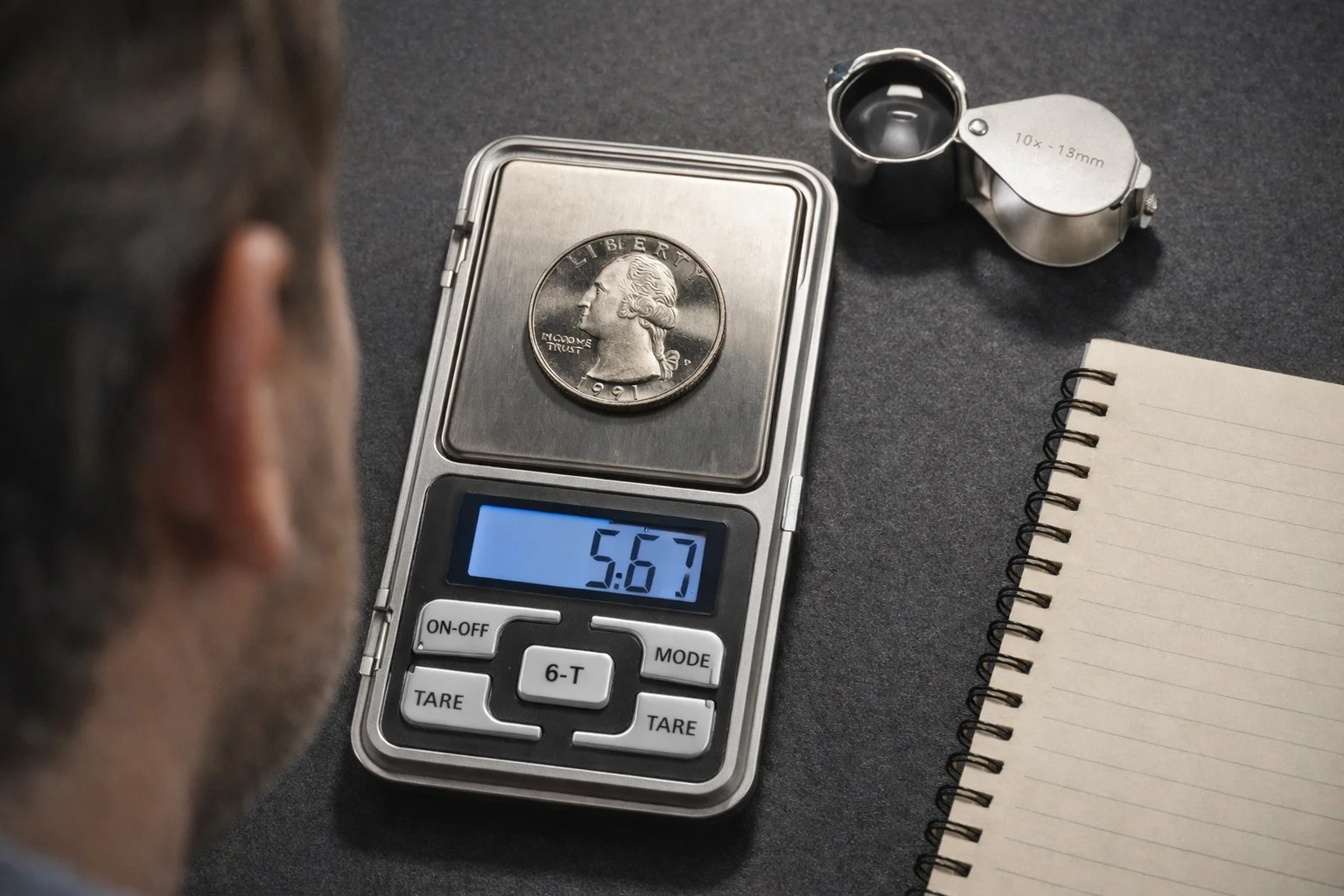
Weigh the coin. It should be close to 5.67 grams.
Inspect the edge. Look for uniformity.
Use 5× to 10× magnification.
Check raised vs incuse features.
Confirm that unusual features are not damage.
Raised anomalies usually originate at the Mint. Incuse cuts usually indicate damage.
When to Consider Grading
Submission makes sense when the error is obvious and substantial. For example, a strong doubled die with clear separation is worth certifying. The same applies to a high Mint State coin with clean, undisturbed surfaces. An original Black Beauty with proper texture and no alteration also justifies grading.
Minor flaws or environmental damage do not. Certification improves marketability. It does not turn a common coin into a rare one.
Final Points
The 1991 Washington quarter is common. Most examples remain worth face value.
But real errors exist, they are collectible and can carry strong premiums when authenticated.
But be careful: most coins advertised as rare are simply damaged. So, learning the difference is critical.
The rule is simple. Verify before assuming rarity. Examine carefully. Compare to confirmed examples. In modern clad coinage, clarity and evidence matter more than claims.